Key takeaways
- Shingle lasts about 30 years and costs roughly $15,000 to $35,000 - the best value per square foot; metal lasts 40 to 70 years at roughly $15,000 to $45,000; tile lasts 50+ years at roughly $30,000 to $70,000.
- Metal roofs are not noisy in the rain - that myth comes from old barn roofs with no decking underneath; a residential metal roof over solid decking, underlayment, and insulation is as quiet as any other material.
- Install quality and attic ventilation determine how long any roof actually lasts in South Florida - the material only sets the ceiling, and coastal homes need corrosion-resistant fasteners and details.
- Titan installs all four systems including flat and low-slope, gives an honest per-home recommendation, and completes the wind-mitigation form, though we do not file insurance claims.
There is no single best roof for South Florida
If you ask three contractors what to put on your roof, you may get three different answers - and all of them can be right. South Florida punishes every roof the same way: salt air corrodes fasteners, UV degrades materials faster than almost anywhere in the country, and hurricane-force gusts test every connection. But the right material for your specific home depends on your roof shape, your architecture, how long you plan to stay, and your budget. There is no universal winner.
Titan has been roofing South Florida homes since 1981. We are dual-licensed by the State of Florida - Certified General Contractor CGC1537612 and Certified Roofing Contractor CCC1334624 - and we install all four common systems: architectural and impact shingle, metal, tile, and flat or low-slope membrane. Because we install all of them, we have no reason to steer you toward one. This guide lays out the honest trade-offs so you can walk into your inspection already knowing the questions to ask.
Shingle: the best value per square foot
Architectural and impact shingles typically last around 30 years in South Florida and run roughly $15,000 to $35,000 for an average home, which makes shingle the lowest entry point of the three and the strongest value per square foot. Impact-rated shingles carry a UL 2218 Class 4 rating and, installed as a full system, can be rated to very high wind speeds - our engineered roof systems are designed to 175+ mph, which covers the design wind speeds across South Florida hurricane zones.
Shingle suits traditional and most builder-grade architecture, and it sits comfortably on a wide range of roof shapes. The honest catch in Florida is lifespan: 30 years is the high end of the range, and a cut-rate install with poor ventilation will fail well before that. UV and heat are what kill shingles early here, so attic ventilation and underlayment quality matter as much as the shingle brand itself.
Best for: homeowners who want the lowest upfront cost, traditional curb appeal, or who expect to re-roof again before they sell. If you are staying in the home a long time, it is worth comparing the lifetime cost against metal or tile before defaulting to shingle on price alone.
Metal: the longest practical lifespan and the noise myth
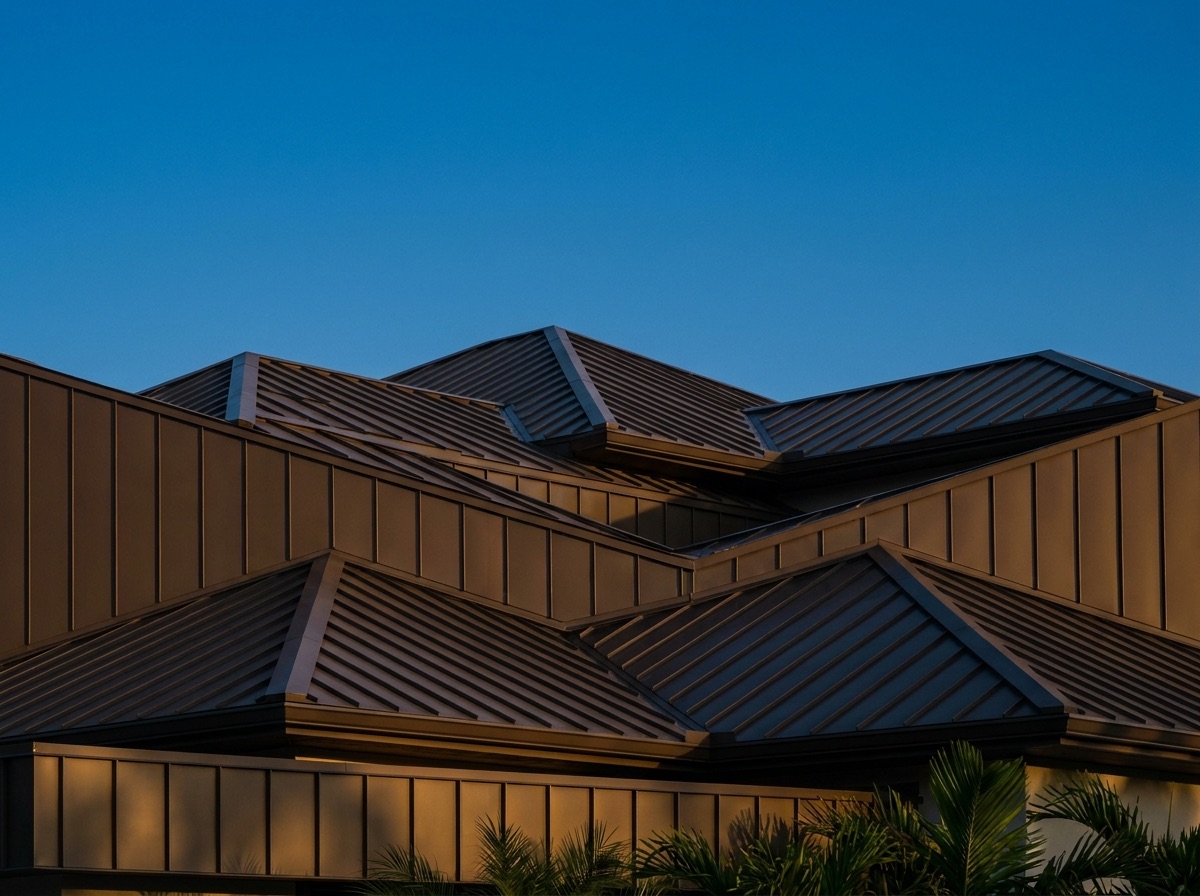
Metal roofing lasts 40 to 70 years and runs roughly $15,000 to $45,000 for an average home. That range overlaps with shingle at the low end, so metal is not automatically the expensive option - it depends on the panel system and your roof. Standing-seam metal with a quality PVDF finish reflects a large share of solar heat, resists salt-air corrosion well when the right coating and substrate are specified for a coastal address, and carries some of the best wind ratings available. For owners who plan to stay 15 years or more, the long lifespan often makes metal the lowest cost per year of any option.
Now the myth worth debunking honestly: metal roofs are not loud in the rain. That reputation comes from old barn and shed roofs, where metal was nailed straight to open framing with nothing underneath. A real residential metal roof sits over solid decking, underlayment, and attic insulation - the same layers that sit under shingle and tile. Those layers dampen rain noise to levels comparable to any other roofing material. You do not hear a drum in a properly built metal roof. What is true is that a poorly built one, on thin decking with skimped insulation, can be louder - which is another reminder that install quality is the real variable, not the metal.
Best for: owners staying long-term, contemporary or coastal architecture, and anyone who wants the longest practical lifespan from a single install.
Tile: the iconic Florida roof, and the heaviest
Concrete and clay tile commonly lasts 50 years or more - longer than most homeowners will own the house - and runs roughly $30,000 to $70,000 for an average home, the highest of the three. You are paying for both the longest lifespan and a look that defines South Florida: Mediterranean and Spanish Colonial barrel tile, plus cleaner flat-profile tile on contemporary homes. Tile handles UV and salt air extremely well because the individual pieces are largely inert; they do not corrode or degrade the way fasteners and asphalt can.
The honest catch with tile is weight and structure. Tile is significantly heavier than shingle or metal, so the roof framing has to be engineered to carry it. On a home built for tile this is a non-issue, but converting a shingle roof to tile may require a structural review and reinforcement, which adds cost. That is exactly the kind of thing we check during an inspection rather than discover halfway through a tear-off.
Best for: homes whose architecture calls for it - Mediterranean, Spanish Colonial, or contemporary - and owners who want a roof that likely outlasts their time in the house. If the framing already supports tile and the look fits, it is hard to beat for longevity.
Coastal performance, flat roofs, and the part nobody sees
Near the water, salt air is the quiet enemy. It attacks fasteners, edge metal, and any exposed hardware long before it touches the visible roofing material. This is why a coastal job has to be specified differently - corrosion-resistant fasteners and finishes, the right substrate on metal, and sealed details at every edge and penetration. The material on top matters, but the connections underneath are what actually decide whether a roof survives twenty salt-air summers.
Many South Florida homes also have flat or low-slope sections - additions, porches, and modern designs - that no pitched material covers well. Those are handled with a heat-welded single-ply membrane system, typically a reflective TPO, paired with proper drainage engineering so water sheds instead of ponding. We install these alongside any of the three pitched materials, so a single home can run tile on the main roof and membrane over a flat addition with no conflict.
Across all four systems, the single biggest determinant of how long your roof lasts is not the brand on the box - it is install quality and ventilation. An unvented Florida attic can reach 140 degrees in summer and cook a roof from underneath, shortening the life of any material. Closer fastener spacing, self-adhered underlayment as a secondary water barrier, correct flashing in valleys, and proper ridge ventilation are the difference between a roof that reaches the top of its lifespan range and one that fails early. The material choice sets the ceiling; the install decides whether you ever reach it.
So which one fits your home?
Stripped to the essentials: shingle is the best value and the right call when budget leads or you will re-roof before selling. Metal gives you the longest practical lifespan and the lowest cost per year if you are staying put, and the noise concern is a myth on a properly built roof. Tile is the longest-lasting and the most iconic look, best when your architecture calls for it and your framing supports the weight. Flat and low-slope sections get a membrane system regardless of what covers the rest.
Because Titan installs all four, our recommendation is tied to your house, not our inventory. During a free inspection we look at your roof shape and pitch, your home architecture, your framing, how close you are to the coast, how long you plan to stay, and your budget - then we give you the honest answer, even when that answer is the less expensive material. We also complete the wind-mitigation form and provide the supporting documentation your insurer needs to apply your discount. To be clear, we do not file or negotiate insurance claims on your behalf - we are not public adjusters - but the paperwork that earns your premium credit comes standard with every roof we install.